Sunday, October 7, 2012

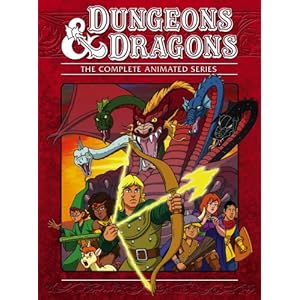
Dungeons & Dragons: The Animated Series


Cartoons in the ‘80s were a bit of a mixed bag.  The cynics will tell you that ‘80s cartoons were just elaborate advertisements created to sell action figures and other merchandise—commercials with commercials.  But while marketing toy lines was certainly a consideration, the idea that ‘80s cartoons had no substance is false.  Many—nay, MOST—of the cartoons from the 1980s were enjoyable to the kids who grew up on them—and a number of them are still great to watch today.

For this entry, we’re going way back to the mid-1980’s—really the dawn of “The Golden Age For Kids”—to remember a cartoon that helped pave the way for a lot of the best cartoons and kids shows of the next 15 years.  I didn’t watch Dungeons & Dragons in its original run, as I was only a small child when it first aired, and I’ve never played the role-playing game either.  But after hearing some good things about the show and realizing that the entire 27 episode series was available on Amazon for less than $10, I thought I’d give it a shot.
And I’m very glad I did.


Overview

On a trip to an amusement park, a group of 6 kids (5 teens, 1 pre-teen) decide to check out a Dungeons & Dragons ride.  However, something goes wrong on the ride and they are unexpectedly transported to a strange and mysterious realm—the realm of Dungeons & Dragons.  There they meet fierce opponents, including the evil sorcerer Venger and the 5-headed dragon Tiamat.  Their guide to the realm is the wise and powerful but enigmatic Dungeon Master, who grants each of the six kids a role and a power: Ranger, Barbarian, Thief, Magician, Cavalier and Acrobat.  The kids use their powers/weapons to defend themselves and fight against evil as they move through the realm trying to find a way back home.

Principle Characters

Hank
dungeonsdragonscartoon.com
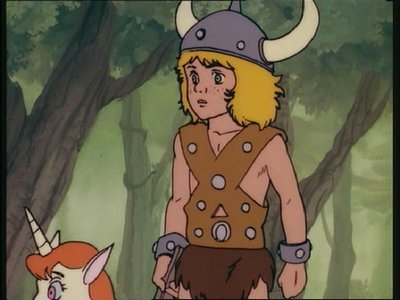
The blonde-haired, blue-eyed Hank is the group’s natural-born leader.  It’s never specified, but Hank is your standard “captain of the football team” type.  He’s decisive, level-headed, principled and courageous.  Dungeon Master makes Hank the Ranger, meaning he has a longbow that shoots energy arrows.  There is no central protagonist in D&D, but Hank is probably the closest thing.  I imagine that young boys watching the show would look up to Hank the most.  Hank is voiced by Willie Aames who many Golden Agers may remember as Buddy Lembeck from Charles in Charge.

Sheila
nightmarefuelpodcast.blogspot.com
Blue-eyed, red-haired and freckled, Sheila is the group’s most emotional member and at times provides a mother-like presence.  Dungeon Master proclaims her to be the Thief—which apparently does not carry a negative connotation in the realm of D&D.  Her “weapon” is a cloak that makes her invisible when she puts on its hood.  While it’s probably not the coolest weapon of the bunch, it helps the gang escape from a number of difficult situations.  Many hints are given that Sheila’s feelings for Hank may go beyond just friendship, but nothing is ever confirmed.


More than Friends? via thatguywithglasses.com

Bobby
absoluteanime.com
The group’s youngest member by several years, the impetuous Bobby is Sheila’s younger brother.   Playing the role of Barbarian, Bobby wields an oversized club that shakes the earth when he slams it down.  Like his sister, Bobby is an emotional character, a little bit temperamental and very protective—especially of Uni, the group’s unicorn mascot. 


Presto
via DeviantArt
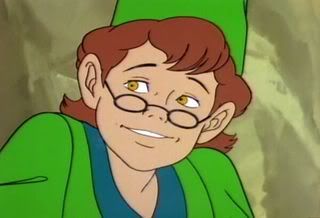
A bumbling amateur magician known for botching card tricks in the earth realm, Presto’s role in the realm of D&D isn’t all that unfamiliar as Dungeon Master conveniently decides that he will be a magician.  Unfortunately for Presto, his difficulties performing magic tricks persist in the new realm too.  This leads to Presto lacking in self-confidence.  His hat has magical powers, enabling him to cast spells and pull key items from it to help the crew in times of peril.  The only problem is that Presto rarely gets it right and more often ends up pulling something ridiculous from his hat, providing a little levity.  Once in a while though, Presto comes through and saves the gang with his magic.


darkhorde.blogspot.com

Diana
The tough but friendly Diana is given the title of Acrobat, which works well since in the earth realm she was an all-state gymnast.  Her weapon is a magical staff, which she often uses in more of a pole vault fashion.  Diana is amicable, courageous, and very independent.  Other than Hank, she seems to be the group’s strongest leader.  Overall, Diana is a good role model for female D&D fans and is probably the character who would be most fun to hang out with in real life.


Eric
kazimskorner.blogspot.com
The ultra-sarcastic Eric fills the “wise-cracking sidekick” role for the group.  A spoiled child of wealthy parents in the earth realm, Eric is prone to whining about the group’s situation.   He’s also famous for acting tough but cowering when facing a dragon, monster, or other enemy.   Though his friends tend to view him as a complainer and a general pain in the butt, Eric’s cynicism is very accurate at times and his frequent questioning of Hank’s leadership provides the group with an important voice of dissent.  He also brings some comic relief—many times the whole group will get a good laugh out of watching Eric freak out about some harmless creature chasing him.  Dungeon Master makes Eric the Cavalier, meaning he has a protective shield.  Despite acting cowardly at times, Eric steps up and uses his shield admirably to defend the group from attackers on more than one occasion.  Eric is voiced by Don Most, famous for his role as Ralph Malph on Happy Days.

Dungeon Master
The mysterious Dungeon Master presents himself to the kids as their guide to the realm of Dungeons and Dragons.  Appearing as a very small and bald old man, Dungeon Master is also a supremely powerful wizard and is very knowledgeable about the realm.  He tends to communicate in riddle form, often befuddling the children.  There is a certain Yoda-like quality to Dungeon Master, but at times it seems like he is deliberately withholding information from the kids, and his true motives are hidden.  Dungeon Master seems to have an interesting relationship with Venger, the realm’s most dangerous sorcerer and most feared villain, but details are scarce.

Venger
dungeonsdragonscartoon.com
If Dungeon Master is the realm’s Yoda, Venger is its Darth Vader.  An evil Sorcer, Venger is known for his fangs, his bat-like wings, and his iconic one-horned helmet.  He rides a black stallion that can fly through the sky.  In addition to his own powerful magic abilities, Venger is in control of an army of orcs and has a shadow demon as his right hand man.  The only force in the realm more powerful than Venger is the dragon Tiamat.  Venger seeks the 6 weapons that the protagonists possess, for if he can obtain them he will be strong enough to defeat Tiamat and control the realm.  Venger is voiced by Peter Cullen, most famous for voicing Optimus Prime throughout the Transformers series and Eeyore in Winnie the Pooh.


Episode Structure

Episodes of D&D:TAS tend to follow a pretty standard pattern.  The group will be meandering aimlessly or working toward some forgettable task when Dungeon Master will mysteriously appear from nowhere.  He’ll provide them with a cryptic clue of how they might get home, often using puns and riddles rather than simply telling the kids what to expect.  Then, just as quickly as he arrived, Dungeon Master seemingly vanishes, and the heroes are left to try to decipher his directions.

via thetrades.com
They’ll set out in whatever direction Dungeon Master told them, but on the way they will run into some other person or group who is either imprisoned in the realm or somehow being victimized by a monster or a spell.  The heroes will nobly put the interest of this person/group ahead of their own and free them from their captors.  Somewhere along the way Venger gets involved but he is fended off.  It’s a happy ending for the victims, but Hank, Sheila, Bobby, Presto, Diana and Eric are still stuck in the realm without much direction.  Dungeon Master tends to show up again near the end, and it will become clear that helping the helpless and/or freeing the oppressed was his ulterior motive all along.  Most episodes end on a light note, often times with Eric getting himself into a sticky situation to the amusement of the others.

Miscellaneous Thoughts & Analysis

It took a few episodes for me to fully latch on to D&D.  It started a bit slow, but once you got a little more familiar with the characters it was really an engaging cartoon.  By the time I got to the last episodes, I was really sad to see it end.

There are a lot of “surface” things to like about D&D.  It’s set in a colorful realm that provides all of the necessary ingredients for a good story.  The main characters are fairly well-written and generally likeable in their own way.  Also, many of the characters that the heroes encounter in their travels have compelling backstories.

Venger's Castle, via dungeonsdragonscartoon.com

But probably what stands out most about D&D was that it had a little bit more depth than its predecessors.  In the ‘70s most of the cartoon offerings on television were pretty sanitized, like Super Friends, Scooby-Doo, or Yogi Bear.  D&D was one of the first cartoons to really step outside of that space and show that kids could handle action and slightly more mature plots, and that animation was an acceptable way to deliver that content.  The show was not without controversy though—the National Coalition on Television Violence demanded that the FTC run a warning before each episode and claimed that it had been linked to real life violence and deaths.

D&D treated its viewers like they were capable of handling more than the same old formulaic kid stuff.  One of the ways that that was manifest was by having storylines that wove through multiple episodes.  For instance there are many allusions throughout the show that there is more to the relationship between Dungeon Master and Venger than what meets the eye.  This subtext persists for a while, until the final moments of the episode “The Treasure of Tardos” when DungeonMaster says sotto voce (at a time when no one except the viewer can hear him): “There was good in Venger once—a long time ago.  Everyone makes mistakes—Venger was mine.”  The true nature of their relationship isn’t revealed until the series’ (unaired) final episode.

The true nature of Dungeon Master & Venger's relationship
is clouded.  via thatguywithglasses.com

The show also delivered some more mature themes at times.  Maybe the most popular episode among the show’s fans is Season 2’s “The Dragon’s Graveyard”.  For the first time the heroes voice their frustration with Dungeon Master for using them to fix up other problems in the realm.  They end up in the home of Tiamat—the mysterious “Dragon’s Graveyard”—and Hank is faced with a decision of whether he should kill Venger  if it helps the gang get home.  One of the show’s writers, Michael Reaves, suggested that that episode and scene “caused a battle royale with Broadcast Standards and Practices.”
 
Jossef Muller, the Nazi who finds redemption
in the realm of Dungeons & Dragons 
Another great episode that was far more mature than you’d expect was Season 3’s “The Time Lost”.  In this episode Venger uses his “Crystal of Chronos” to warp space and time, and he pulls both a futuristic fighter jet and World War II Luftwaffe plane into the realm of Dungeons & Dragons.  Venger’s goal is to send the Nazi pilot—a man named Josef Muller-- back to the earth realm to win World War II for Germany, thereby altering Earth’s timeline and preventing the kids from ever entering the realm of D&D.  But after meeting the heroes, the Nazi pilot has his eyes opened and eventually finds redemption.  This particular storyline was so mature that I almost couldn’t believe what I was seeing when I watched it.  It’s not every day that you see a Nazi as a central character in an 80’s kids cartoon.

D&D:TAS actually has a lot of similarities to one of my favorite post-Golden Age tv shows: LOST.  In both shows, a group of unwilling passengers crash land in a strange and mysterious place, and the plot of the show revolves around their quest to find a way back home.  In both shows the protagonists encounter a number of different inhabitants of this strange new place—some good, some bad, and some who have elements of both.  In both shows the person or entity that is portrayed as being the source of all evil (or “big” bad guy) turns out to not be, and both shows force you to question whether the person/entity portrayed as the defender of all that is good and righteous is really so righteous himself.  Heck, both shows even feature nameless pillars of smoke that have existed for thousands of years and that embody true evil.  The similarities are so numerous that it makes me wonder whether or not the creators of LOST watched and were influenced by D&D:TAS.

Dungeons & Dragons' "The Nameless One"
Lost's "Smoke Monster"

This giant statue inside Venger's castle appears to show Venger
with a 2-horned helmet.  Or, perhaps this statue is not OF Venger
but instead someone he idolized.  Since we only see the statue from
behind, we'll never know.
A giant statue seen only from behind?  Hmmmmmmm.


Perhaps the coolest D&D plot is one that never really happened.  The show’s final aired episode, The Winds of Darkness, was good but did not bring the plot to a satisfying conclusion.  One more episode, known as Requiem, was written but never aired.  Over the years there was much discussion about the plot of Requiem, particularly among diehard fans who used the internet forums to communicate.  One of the most popular theories was that Requiem revealed that the kids had actually died on the amusement park ride, and that they weren’t truly in a different realm but in Hell, tortured by Satan in the form of the Dungeon Master.  It’s one of those endings, kind of like “The Sixth Sense”, that just makes you say “Whoaaaaaa”, because it would make so much sense if that really WAS what happened.  Also, reminds me of more than a few “LOST theories” I read through the years.


Of course, it is just an urban legend, as confirmed by Michael Reaves on his personal website.  To clear things up, Reaves went so far as posting a PDF version of Requiem’s script.  While it doesn’t truly wrap up the plot and it’s not quite as shocking as the Hell reveal would have been, it’s still a pretty neat episode in its own right.  Some creative folks in the youtube community did a dramatic reading ofthe script, complete with voices that sounded pretty similar to the real characters.  If you watched the show but haven’t seen the video, it’s definitely worth checking out.

Final Thoughts

Maybe in some cases there is some merit to the idea that ‘80s cartoons didn’t have a ton of substance.  But Dungeons & Dragons, to me isn’t one of those cases.  It has its plot holes and a few other issues at times, but overall it’s a pretty good story that was well ahead of its time in a lot of ways.  IGN, which ranked it the 64th best animated show of all-time, described it as “truly a mature soap opera with swords and monsters.”  I think that’s pretty fair.  The show did a lot of things that were previously off-limits for kids cartoons and was influential in shaping what cartoons would look like in the later years of the Golden Age.  For that we owe it a debt of gratitude—and for less than $10, a watch or re-watch.


Special thanks to DungeonsDragonsCartoon.com, an awesome resource for fans of the show.

Thursday, August 30, 2012

Golden Age ('80s and '90s) School Supplies


This week, as millions of children across the country go back to school, I thought it might be fun to revisit some of the most essential school supplies of the Golden Age.

Notebooks, Folders & Binders

In the Golden Age, organization started and ended with the Trapper Keeper.  It was the one stop shop for all of your folders, notes and paper assignments.  The Trapper was great once you got to middle school or high school because you didn’t have to remember which classes had homework (and therefore required you to bring home the notes) and which didn’t—just keep everything in your Trapper and throw that in your bookbag at the end of the day.

In the '90s Trappers started to feature some futuristic and psychedelic cover designs.  Like just about everything else in that decade, bold and vibrant colors were essential.  The Trapper was more than just a useful school supply, but a way to express yourself.

Even Aunt Beckie from Full House loved them!


Like Trappers, folders were a popular way to show off a favorite team, character or something else personally significant.  And also like Trappers, they came in a variety of bright colors and designs.  Particularly popular among the female crowd in the ‘90s were folders and notebooks featuring the artwork of Lisa Frank.  Frank’s products and artwork were easily identifiable by their bright neon and rainbow colors.  They generally featured female-favorite animals, including unicorns, puppies and dolphins.  Eventually Frank diversified away from folders and stationary products into related goods like pencils, stickers and lunchboxes.  Lisa Frank products were certainly girly, but I have to admit that the bright, vivid colors were quite sharp and distinctly ‘90s. 


Writing Utensils

Of course in order to write in all these nifty notebooks and binders, we needed some writing utensils.  Like most everything else in the Golden Age, the loud and vibrant were preferred over the mundane.  The ultra-flashy Yikes! pencils became popular in the 90’s, featuring bright colors and sometimes holographic designs.  When you sharpened the pencil, the wood portion was dyed a different color, giving the pencil a louder, multi-colored look.  It’s pretty rare to see a successful branding campaign for a product as cheap and commoditized as pencils, but Yikes! was able to pull it off in the ‘90s.


A number of other pencil trends came and went in the Golden Age.  In my elementary school, very popular among the guys were football pencils, which featured an NFL team’s name and/or logo. 


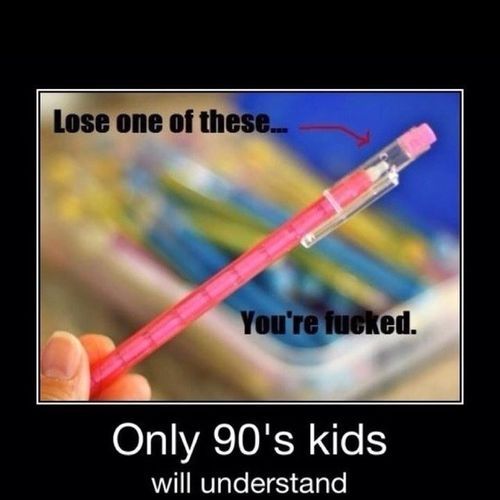
Popular with many girls was the push-up style pencil, where instead of sharpening it down, you removed the top piece, put it in the bottom and pushed up a new sharp piece.  Of course, if you lost one of the pieces, you were done for.


Just having flashy pencils was not enough for us.  In the Golden Age, kids loved to accessorize and jazz up their writing utensils.  “Pencil Toppers” were little decorations that had a hole in them so that we could sit them over-top of the erasers on our pencils.  Pencil Toppers came in a number of forms, but the omnipresent-in-the-90s Troll Doll was a favorite.


Pencil grips, or “grippers” as many kids called them, were also a popular accessory.  Even though the gripper theoretically should have been a stigma, since you generally only got one if you weren’t holding your writing utensil properly and needed a device to help you correct that, it was instead viewed by most kids as a cool way of jazzing up otherwise boring pencils.  The triangular prism gripper was common in the early years, but seemed to give way to a smaller, gel-ier style of gripper as the years went on.


As we got a little older and our teachers gave us the go-ahead to move from pencil to pen, we had a wide array of new directions to go in for our writing needs.  One trend that emerged among '90s girls was gel pens.  Structurally similar to a regular pen, gel pens were distinct for suspending their ink in a water-based gel which was usually visible through a clear pen barrel.  Gel pens came in a variety of colors and were almost never confined to the standard black and blue.  Colors like mint green, pink, lavender and sky blue were favorites.


I’d be remiss if I didn’t mention multicolor pens, which let you select a different color by pushing down a little lever.  You could easily change colors mid-assignment (even though I can’t really imagine many situations where you’d want to).  I am pretty sure every Golden Ager had at least one of these pens, and I’m pretty sure all of us did the same thing—try to push down more than one of the colors (or all of them) at the same time to see what would happen. 


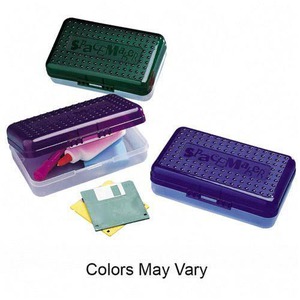
Of course to carry all of these spiffy writing utensils, we needed some sort of case.  Soft pencil cases were popular, but in the ‘90s Spacemaker pencil boxes managed to overtake them.  I tend to think that the pencil box was good if you had a desk to store everything in, or if you were using itat home.  If you were trying to carry it from class to class, it was a little too big and cumbersome.  But it certainly caught on, as most Golden Agers seem to have a clear recollection of the Spacemaker box.


Crayons & Markers
The standard bearer for crayons in the Golden Age was the Crayola 64 box.  Everybody knew that you couldn’t REALLY draw a good picture with an 8 or 10 pack.  The full compliment of 64 colors was essential.  Crayola really outdid themselves when they installed a sharpener right into the back of the box.  If your crayon was getting a little bit dull, all you had to do was peel back the paper a bit, sharpen ‘er up, and you were back in business.  I have no recollection at all of where the shavings went.


In the early 1990s, in conjunction with the release of their colossal 96-crayon “Big Box”, Crayola decided to introduce some new colors to the world in a way that only they could.  16 new fluorescent crayons were added, and a contest was started to name these brand new colors.  As best I can tell, this contest actually ran for over a year, with the winners being announced in 1993.  Some of the new color names included “Robin’s Egg Blue”, “Macaroni and Cheese”, “Timber Wolf” and “Razzmatazz”.  Congratulations Golden Agers, these were your contributions to the world of color.  For a full list of the winners and a really neat history of Crayola through the years, check out CrayonCollecting.Com.


As we got older, it became clear that crayons were for little kids, and if you really wanted a vibrantly-colored picture, you had to go with markers.  Crayola again was the market leader, and their standard 8 pack was usually enough to whip up something “fridge-worthy” in Art class.  But Crayola rocked the marker world in the ‘90s when they invented “Changeables”.  You could write in one color, then a few seconds later you could rub a clear “magic wand” marker over some portion, and the places that were wanded would change to a totally different color.  It might seem ho-hum now, but in the early 
90’s this literally seemed like magic and was pretty much the coolest thing ever.  A short time later, Crayola introduced a cousin to the Changeable—the Overwriter.  You could write something in a dark color—say, black--then write on top of it with a lighter color, and it would actually show up!  Again, mind-blowing in its time.  Some nice girls on YouTube provide a little demonstration to jog your memory.  

But Crayola wasn’t the only marker maker in town.  Who could forget the scented goodness of Mr. Sketch brand markers?  Each marker had a distinct scent that usually smelled like a food item of the same color.  The complete list was: 

  • Red: Cherry
  • Orange: Orange
  • Yellow: Lemon
  • Green: Mint
  • Dark Green: Apple
  • Light Blue: Mango
  • Blue: Blueberry
  • Purple: Grape
  • Pink: Melon
  • Magenta: Raspberry
  • Black: Licorice
  • Brown: Cinnamon


I was partial to the citrusy yellow and orange myself, but most all of them were pretty terrific.  Mr. Sketch markers were also a particular shape that made them easy to connect to each other, which was great for building a marker-tower or a marker-sword—you know, if you were so inclined.  All these years later you can still grab a 12-pack of Mr. Sketch on Amazon for less than $7, if you want to make a picture for your mom, build her a marker tower, or just sniff them “sketchily” while she looks on with concern. 

Lunchboxes

And finally, who could forget the lunchbox, probably the most fun item to select on your back to school shopping trip.  It was (at least) a year-long commitment, so you had to choose carefully.  Being a huge Ninja Turtles guy, they were my lunchbox of choice (me and a few million other kids my age).  My big sister, on the other hand, opted for New Kids on the Block.  There were so many great lunchbox designs in the Golden Age that you almost couldn’t go wrong.


What were your favorite school supplies in the 80’s and 90’s?  Which are kids still using and which have been forgotten by time?  Tweet us @GoldenAge4Kids or drop us a comment.  As always, a big thank you to those whose old photos we've borrowed for this entry.

Thursday, August 9, 2012

Top 10 Movie Themes of the Golden Age


We grew up in a great era for film.  Regardless of the genre, movies in the 1980s and 1990s more often than not delivered with solid acting, well-written plots and tons of memorable moments.  But one aspect of great films that is sometimes underrated by the general public is a great soundtrack.  The Golden Age produced some of the most memorable movie scores and themes of all-time, and in this entry, I’ll weigh in with my Top 10.

A disclaimer: As usual with a Top 10 list, please remember that there is room for differences in opinion.  I’m sure there are some awesome themes that I’ve left out here.  Also, while I typically consider the Golden Age to be the Mid 1980s through the 1990s, the “boundaries” of the age are pretty fluid, and for the purposes of this list I’ve gone a little further back into the 80s for a few tracks.  The idea is to catch themes from movies that our generation grew up on—even if those films were released a little earlier.  That said, I have deliberately left out the themes from movies like Star Wars, Rocky and the Godfather.  Even though those series had movies come out during the Golden Age, they all certainly started in the 70s, and so their music belongs to that generation.  Finally, I tried to keep the list to songs that were either composed specifically for the film they were featured in or songs that were designated as the movie’s “theme” music.  There were a ton of good songs that played in Golden Age movies, sometimes in very memorable scenes, but for this list we’re just looking at movie themes.

Honorable Mention:  Axel F (Beverly Hills Cop Theme)


Ok, so I couldn’t quite find a spot for this one in the Top 10, but it’s definitely worth remembering.  Starring 80s Icon Eddie Murphy, the Beverly Hills Cop series was one of the best action comedy series of the era, helping bring popularity to the genre that would later give us quality Golden Age films like Lethal Weapon, Bad Boys and Rush Hour.  The heavy synth/techno vibe still sounds pretty slick 20-some years later, like you could still throw this track on at a party today.  To kids today, it’s probably better known as “The Crazy Frog Song”, since it was covered by the computer-generated Crazy Frog character and made into a ring tone in the early 2000’s.


10. Forrest Gump Theme


In a movie full of great music, including tracks by Buffalo Springfield, CCR, Bob Seger and Fleetwood Mac, Forrest Gump's orchestral theme still manages to stand out as a brilliant composition.  Composed by Alan Silvestri (who we will see again a little later), the Forrest Gump theme sets the stage for what is, in my opinion, one of the greatest stories ever told in a motion picture.  In particular the part of the score around 2:50 in the video above brings about a flood of emotion and reminds me of the beauty of this terrific film.  Also, the part that begins around 6:55 reminds me of Forrest’s time returning kicks for the Crimson Tide, one of the most memorable parts of this epic movie.


9. Indiana Jones Theme


So, this is my first (and biggest) bend of my own rules, as Raiders of the Lost Ark came out in 1981, a few years before I’d typically say the Golden Age began.  That said, RotLA and the Indy Sequels are distinctly 80s in nature, and many of us grew up on them, so why get hung up on technicalities?  Plus, who could say no to this brilliant piece of music?  It sets the score perfectly for the action and adventure that Harrison Ford’s Indiana Jones character would encounter.  The song also serves as our first reminder of a simple rule that will be proven right time and again in this list: John Williams and the London Symphony Orchestra are amazing and everything they touch is gold.


8. Ghostbusters Theme


This is an example of a movie theme that grew to be almost as big as the movie itself.  Ray Parker Jr.’s Ghostbusters theme not only set the stage for Dan Akroyd and Bill Murray’s 1984 box office smash, it reached the top of the Billboard Top 100 chart the summer the film came out and stayed there for 3 weeks.  Every kid in the Golden Age knew the tune and of course the memorable “I ain’t afraid of no ghost!” slogan.  On a personal level, every Halloween my elementary school would have a little mini-parade in the school parking lot for all the kids to show off their costumes, and the Ghostbusters theme was always played at least once each year.  It’s a warm-fuzzy Golden Age memory for me, and every time I hear the theme I’m reminded of it. 


7. Top Gun Anthem (theme from Top Gun)


I’m not sure that there was a cooler movie made in the 80s than Top Gun.  The film features a lot of great music but only one title theme, and it certainly delivers.  Featuring Harold Faltermeyer (who was also responsible for the Beverly Hills Cop theme) on piano and a big-haired Steve Stevens  absolutely rocking it on electric guitar, the Top Gun Anthem took home a Grammy award in 1987 for Best Pop Instrumental Performance.  Well deserved, I’d say—this song rocked pretty hard and contributed to many Golden Agers wishing they could feel, even for a moment, as cool as Tom Cruise’s “Maverick” in Top Gun.


6. Braveheart Theme


On first listen, you might think that the theme for Braveheart seems very gentle and beautiful for a movie that’s best known for (Mel Gibson as) William Wallace’s rousing pre-battle speech.  But at its core, Braveheart isn’t just about war, it’s about a man who is as brave and noble as they come, who loves his wife, who remembers what his father died for, and who loves his country so much that he is willing to give the last full measure of devotion.  The soft wind instruments mixed with the bagpipes give the song a very sentimental and distinctly Scottish sound.  It was composed by James Horner and performed by—you guessed it—The London Symphany Orchestra.

5. E.T. Theme


Once again I’m stretching the bounds a little bit, dipping into 1982 for this one.  But is there any more classic 80’s kids movie than E.T.?  John Williams did it again here.  Empire Magazine (and a number of other film critics through the years) once proclaimed Elliot and E.T.’s flight to the forest as “the most magical moment in cinema” ever.  High praise, but difficult to argue with, and this theme song is inextricably linked to (and is a big part of) the magic of that scene.  The soaring melody, starting at the 0:13 second mark, mirrors Elliot and E.T. soaring over the forest and past the moon.  As kids, we all watched that scene with a sense of magic and wonder, and listening to the theme now brings those feelings rushing back.  If interested, there is also video on youtube of John Williams conductingthis song live, and the crowd literally cannot help but gasp and applaud when the melody soars at the :07 second mark.

4. Don’t You Forget About Me (The Breakfast Club Theme)


An absolute 80s anthem.  The Breakfast club is the prototype for a teen movie, telling the story of 5 high schoolers with completely different backgrounds who are all brought together by having to spend a winter Saturday in detention.  The song is awesome by itself, one of my favorites from a decade filled with amazing music, and it topped the charts in more than  one country.  But its association with a classic movie like the Breakfast Club makes it truly unforgettable.  You can’t think of one without the other, and they’re both top-notch.  As an aside, any time you walk underneath a goalpost, it’s obligatory to mimic Bender’s fist pump at the end of the movie and sing or hum this song.

3. Jurassic Park


Perhaps more than any other song on this list, this theme transports me back in time to my childhood.  I remember it like yesterday: it was field day at our elementary school, a Friday afternoon about a week before school let out for summer, and a friend’s dad offered to take a bunch of us to the movies to see the new movie called Jurassic Park.  Needless to say, all of us were completely blown away by the film and the (at that time) state-of-the-art special effects that made the dinosaurs seem so real.  Of course, when you watch it back now the effects don’t seem nearly as impressive, but the music has held up wonderfully, maybe even gotten better with age.  Like Forrest Gump, the main theme really contains a few different movements—one which is the most epic and which plays as the helicopter arrives and a bit later when the old guy says “WELCOME… to JURASSIC PARK!”; another more gentle piece that plays when the main characters first see the island’s dinosaurs; and a final piece which plays during the movies more tense scenes.  John Williams, you have done it again sir. 

2. Promontory (The Last of the Mohicans Theme)


Holy crap this theme is epic.  Crank the volume up in your headphones and enjoy this beautiful piece from Trevor Jones and Randy Edelman.  Based on the 19th Century novel by James Fenimore Cooper, The Last of the Mohicans was one of the most critically acclaimed films of 1992 (and still has 97% positive at Rotten Tomatoes).  Starring Daniel Day Lewis as Hawkeye, the movie is set in 1757 during the French and Indian War, when America was almost entirely a vast and untamed frontier.  “Promontory” was actually based on a tune called “The Gael” by Scottish songwriter Dougie MacLean, and I think you can certainly hear the Scottish influence in the violin sound.  It sets the perfect tone for the movies tale of love and war, very similar to Braveheart’s theme.  In the last decade the track saw a bump in popularity: first it was featured in a viral video about the changing globalsocio-economic picture, then shortly thereafter in a Nike commercial featuring Steven Jackson and Shawn Merriman.

1. Back to the Future Theme


“Roads?  Where we’re going, we don’t need roads.”

Topping our list is the classic theme from my favorite movie of all time (though I tried to not be biased), Back to the Future.  Composed by Alan Silvestri, the film’s score plays many times throughout the movie, but perhaps most memorably during the scene where Doc slides down from the clock tower to ensure Marty’s return to 1985—for my money, one of the best scenes in any movie ever made.  There’s a very magical quality to this film, and every single time I hear this theme it makes me want to immediately drop everything and go watch it.  It will never get old or tired, it will always be a classic, and for me it’ll always be the #1 theme in a Golden Age for movie themes.

So, that’s our Top 10.  Who did we overrate?  Who did we leave out altogether?  We’d love to hear your list—post a comment or hit us on Twitter @GoldenAge4Kids

Wednesday, July 4, 2012

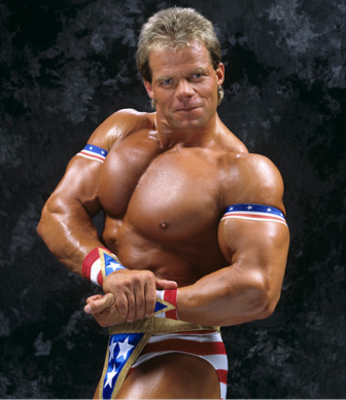
Lex Luger: My Hero, 1993


Happy 4th of July to all those in the US celebrating.  Hope you’re having a great day of cookouts, swimming and fireworks with the people who matter most in your life.
On this Independence Day I wanted to look back on one of the most memorable wrestling storylines of the Golden Age, which kicked off exactly 19 years ago today. 


The Slam Heard ‘Round the World

In the summer of 1993, Yokozuna was on top of his game.  He was the WWF Champion, and he was fresh off of beating Hulk Hogan and sending him packing from the company at the first King of the Ring pay per view.  Feeling supremely confident in himself, the 550+ lb champion and his manager Mr. Fuji scheduled an open challenge onboard the historic USS Intrepid aircraft carrier in New York for any athlete, wrestler or otherwise, to try to slam Yokozuna.  If they could do it, they won a new Chevy pick-up truck.  A number of football players, hockey players, basketball players and wrestlers tried to slam the mammoth champion, but nobody could.  Yokozuna taunted the contestants and the crowd by taking time out to eat rice.  Then, one final contestant stepped up to the challenge: Macho Man Randy Savage.  The crowd thought he might be the guy to do it—but it wasn’t meant to be.  The champ was just too big, and he and Fuji had succeeded in proving Japan’s superiority on July 4th.

But just then, as the dejected crowd began to accept that it was over, a helicopter appeared and landed onboard the Intrepid.  The crowd buzzed with excitement wondering who would step out of the chopper to potentially save the day.  It was---Lex Luger…?!?  Up to that point, Lex had been a self-absorbed bad guy.  But on this day he was dressed in red white and blue, walking toward the ring with a purpose, throwing long-time supporter Bobby Heenan out of the way as he went.

When he got to the ring, Lex had a few choice words for Yoko and Fuji, telling them that bloodsuckers like them were the only thing wrong with America.  Despite their assertions that the contest was over, the crowd wouldn’t let the day end without Lex getting his shot.  They squared off and Yoko charged, which Lex dodged like a matador sending Yoko into the turnbuckle.  As he turned around, a bit staggered, Lex picked him up and bodyslammed him.  The crowd went wild and Luger celebrated like a mad man.  Other wrestlers picked him up on their shoulders as he waved American flags.  It was quickly dubbed “The Slam Heard ‘Round the World”. 

And with that, the Summer of Lex Luger was officially kicked off.


The Call to Action Campaign


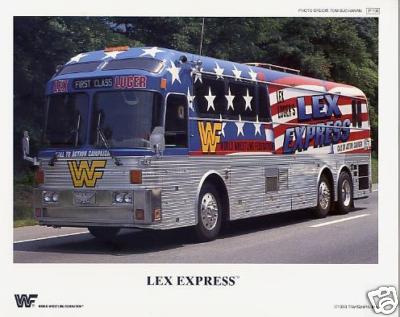
Lex immediately challenged Yokozuna for the title at Summerslam, but Yoko and Fuji declined the match.  So, Lex did what any warm-blooded American would do—he took his campaign to the people.  Dubbed the “Call to Action Campaign”, Lex spent several weeks in the Summer of ’93 traversing the country on a bus called “The Lex Express”.  He was shaking hands, kissing babies, signing autographs and making his case to the American people.  Now, why exactly he needed to make his case to the American people when the challenger for the title was not decided by popular vote is not completely clear.  But it doesn’t matter.  What matters is that the Call to Action Campaign produced the single most epic montage video in the history of professional wrestling.  I present to you, “I’ll Be Your Hero”:


There are so many great things about this video that it’s difficult to list them all. But a few of my favorites include:

  • the 80s-esque soundtrack
  • the “dramatic” camera shot of the Lex Express in the distance, gradually getting closer
  • Overlaid images of great Americans like a soldier, the Iwo Jima Memorial, George Washington and Abraham Lincoln
  • Lex wearing lightweight “stars and bars” sweats seemingly everywhere, including while sleeping on the Lex Express, hugging an American Flag pillow
  • Lex flexing in front of Niagra falls
  • Lex standing on top of the Lex Express and posing in front of Mount Rushmore
  • Lex’s expression at 3:15
  • Lex posing with a number of disabled kids
  • Lex wearing a fanny pack seemingly everywhere

Eventually the campaign accomplished its goal, and Lex was awarded his title shot against Yokozuna at Summerslam 1993.  

The Match

The stipulations indicated that it would be Lex’s one and only shot at the WWF tile.  As the crowd at the Palace of Auburn Hills waved flags and chanted “U-S-A, U-S-A”, Lex battled it out with the monstrous champion.  Lex eventually slammed Yoko once more, slightly less cleanly than the Slam Heard ‘Round the World.  With his patented running forearm, Lex was able to knock the behemoth out of the ring and win the match via count-out.  Unfortunately, the title cannot change hands via count-out.  As balloons fell from the ceiling and “The Stars & Stripes Forever” blared, Lex celebrated the win with other wrestlers, but it was a bittersweet victory as he was not able to win the title.

Lex went on to captain a team of “All-Americans” to a victory over The Foreign Fanatics at Summerslam 1993.  At the 1994 Royal Rumble, he was named co-winner along with Bret Hart, which set up a rematch with Yokozuna for the championship at Wrestlemania X.  While Luger clearly outwrestled Yokozuna and had him pinned, special guest referee (and former Luger nemesis) Mr. Perfect disqualified Lex for putting his hands on an official.  Lex would never reach his goal of winning the WWF title.  After feuding with Tatanka and the Million Dollar Corporation through the rest of 1994 and briefly teaming with the British Bulldog in early 1995, Lex left the WWF to return to WCW.


Miscellaneous Thoughts

This is one of my favorite wrestling angles of all time, because I feel that it really captured the essence of wrestling in the Golden Age.  All of the patriotism, the oversized and seemingly unbeatable heel, the muscle-bound face, the flag-waving, the cheesy montage… others may sneer at that paradigm for wrestling, writing it off as “wrestlecrap”.  But in its time it was awesome, and I love going back to watch it.  It was an era when wrestlers were larger than life, giants among men.  And wrestling matches weren’t just contests to see who got to wear a piece of gold around their waist, they were clashes of the titans to determine who was the best in the world.   


Conventional wisdom among the internet wrestling fan community is that the All-American storyline was a major failure for the WWF.  I wouldn’t deny that maybe it wasn’t exactly what they thought it would be.  From the moment the chopper began its descent onto the Intrepid, fans clearly thought it was going to be Hulk Hogan coming out to slam Yoko and save the day for the USA.  That was perfectly logical since after all, Hulk had wrestled at WWF King of the Ring just 3 weeks earlier, and back then nobody had the internet to clue us in when wrestlers were changing companies.  When it was Lex who showed up, people were clearly a bit disappointed; and since he had up to that point been a heel, fans were not as quick to latch on to him. 

WWE put the full strength of their hype machine behind Lex, and I personally enjoyed it.  But in truth, they were clearly trying to make Lex their new Hulk overnight which was simply impossible.  Lex may have been good, but nobody can walk in Hogan’s footsteps.  You can’t just recreate Hulkamania in the span of a month or two, no matter how good your marketing people are.  I think the summer of 1993 probably made that clear for Vince McMahon, who prior to that liked to think that his creativity and marketing were what really made Hulkamania explode.


Plus, by 1993, it wasn’t really what fans wanted anymore.  It was still a few years before the formal beginning of the Attitude Era, but by '93 fans had had enough of super-faces.  The crowd may not have been ready for the full-out anti-hero like Stone Cold Steve Austin yet, but they’d had enough of muscle-bound, flag-waiving, baby kissing good guys and they wanted something different.  Lex, in his stars and bars sweatpants and fanny pack, represented more of the same.  To that extent, I think WWF/Vince McMahon inadvertently set Lex up to fail by failing to realize that consumer preferences had evolved from the late 1980s.


But overall, I still think that angle went fairly well.  If you listen to the crowd at Summerslam 1993, they’re still very solidly in Lex’s corner.  A good portion of the fans were rooting for him to be crowned the winner of the Royal Rumble the next year and fans were solidly behind him again at Wrestlemania X.  Whatever his reasons were, Vince decided not to go through with the title change at Summerslam 1993, giving the fans a very unsatisfying count-out finish instead.  The common refrain about the storyline has thus become “Well, Lex just wasn’t getting over enough.  It just wasn’t working.  So they couldn’t give him the title.”  I disagree.  I don’t think giving the title to Lex at Summerslam 1993 would have been a disaster at all.  I think it would have been met with a favorable reaction from the crowd, just like Bret’s title wins in 1992 and 1994 were.  The decision to not give Lex the belt has changed most people’s perspectives on how the storyline actually went, in my opinion.  People assume that Lex must not have been too well-received if Vince didn’t give him the title, but in truth, the casual fan was very much behind Lex in ‘93.  I certainly have my issues with Lex Luger, particularly around his treatment of Miss Elizabeth in the weeks and months leading up to her death, and he doesn’t seem to have the greatest of reputations among other wrestlers of the era.  But I think his performance in the All American role was as much as you could have asked for, and I certainly have fond memories of what I consider to be a great summer for wrestling.

Until next time, enjoy the musical stylings of "Rappin'" Randy Savage and M.O.M.:


Happy 4th!