Showing posts with label Wrestling. Show all posts

Sunday, January 13, 2013

Top 10 Wrestling Themes of the Golden Age


Greetings fellow Golden Agers!  Hope the new year is treating you well thus far.

This week, we’ll take a look at the Top 10 wrestling themes of the Golden Age.  For anyone who is new to the blog, “The Golden Age” is a period stretching from the mid 1980s through  roughly the mid to late 1990s.

Only one restriction for this list—the song must be composed specifically for the wrestler(s) using it.  So for example The Sandman’s use of Metallica’s “Enter Sandman” was excellent, but that song existed long before he ever used it.  Ditto Ricky Steamboat and “The Alan Parsons Project” song.  Unfortunately this rule also nixes some classics like Randy Savage’s “Pomp & Circumstance” or Ric Flair’s “Also Sprach Zarathustra”, but on the bright side there are plenty of great themes even without those classics.

Honorable Mentions: Bret Hart, Harlem Heat, Razor Ramon, Ted DiBiase, Kurt Angle


10. New World Order


Hulk Hogan’s joining of The Outsiders in 1996 created the greatest stable in the history of the wrestling business.  The nWo’s theme became synonymous with the brash, bad boy attitude that made them hated by many in the ‘90s.  Who could forget the Hulkster, beard dyed black, sauntering out to this theme and playing the spray painted championship belt like a guitar?


9. The Fabulous Rougeau Brothers


One of the most overlooked tag teams of the era, Jacques and Raymond Rougeau were one of WWF’s top heel teams in the 1980s.  The real life brothers from Montreal used a gimmick where they’d pretend to support America, even waving tiny American flags as they came to the ring, but they clearly did not have real allegiance to the USA.  A fun fact about their theme music is that they pretend to be patriotic “All American Boys” while singing in English, but when they switch to French they are actually dissing the USA.


8. Strike Force’s “Girls in Cars”


Tito Santana and Rick Martel were among the WWF’s most exciting wrestlers in the late 80s.  When they combined to form a new tag team called "Strike Force", a hip, flashy entrance theme was needed.  In 1987, Strike Force got just that with Robbie Dupree's “Girls in Cars” off of the WWF Piledriver album.  They typically entered arenas to an instrumental version, but the version with lyrics and the song’s music video are so deliciously ‘80s that they must be savored in their original brilliance.  If you’re anything like me, you’ll never forget the 8-bit version of the song which served as Ted DiBiase’s theme (Ted didn’t have entrance music in those days) in WWF Wrestlemania for the NES.  It would get stuck in your head for hours.


7. Goldberg


Storming onto the scene in a big way in the late 1990s (the twilight years of the Golden Age), Bill Goldberg had maybe the hottest stretch of months that any wrestler has ever had in the entire history of the wrestling business.  Crowds packed arenas and tuned in to Nitro week after week to watch this new phenom destroy his next victim and build his undefeated streak.  A large part of the Goldberg mystique was his entrance, complete with sparks flying and Bill snorting smoke out of his nose like a bull.  His theme had a distinctly military influence with all those drums pounding.  It got everyone in the arena psyched up and ready for battle.


6. Demolition


One of the greatest tag teams of the Golden Age, Demolition’s thundering “Pain & Destruction” was one of the heaviest, hardest rocking wrestling themes of all time.  Sung by rocker Rick Derringer, the track’s heavy drum sound, electric guitar and raspy vocals formed an intimidating soundtrack as the face-painted and spiked leather-clad Ax and Smash made their way to the ring.  Perhaps better yet were the foreboding lyrics—“Run and we’ll find you”, “There’s no place to hide”, “Pain and destruction is our middle name.”  Demolition looked like a cross between bad ass bikers and clowns from hell, and Deringer’s theme contributed to what every wrestling fan thought upon seeing them—“Wow, I wouldn’t want to mess with these guys…”


5. The Crow Sting


Probably my favorite WCW angle of all time, Stings journey from a blonde, happy-go-lucky babyface to a dark, silent, and mysterious figure of the shadows was a central storyline in 1997.  He’d appear in the rafters, wearing a trench coat and carrying a baseball bat, face completely expressionless.  Occasionally he’d come down from the rafters, lay out one wrestler or several, only to disappear again into the darkness—and he never said a word.  The enigmatic nature of the character was captivating, and fans couldn’t wait to finally get some answers on what had happened to Sting, what he was thinking and what he would do next.  When he finally did wrestle, Sting used this theme, which was a great fit for his character’s dark and mysterious persona.  It is a simple piece of music, but a perfect fit.


4. The Ultimate Warrior


Has there ever been a more fitting wrestling theme than the Warrior’s “Unstable”?  The pounding drum and blaring guitar form a simple but frenetic entrance theme, perfect for Warrior’s “sprint to the ring and shake the ropes” routine.  In recent years it has become common for fans to make fun of Warrior for (a) not being a great wrestler and (b) being a little bit crazy, but you can’t knock his success.  Crowds went wild for him and his gimmick was actually interesting.  The moment you heard those drums hit “DUN…DUN DUN DUN….” you knew you were going to be entertained. 


3. Hulk Hogan


You knew it was just a matter of time before we got to this, right?  Arguably the most iconic entrance theme in the history of wrestling “Real American” was the theme song of Hulkamania, a movement which took wrestling to heights it had never seen before and which created the business as we know it today.  The guitar work is great, but the lyrics are what make Real American special.  They nicely summed up what Hulkamania was all about—patriotism, courage, persistence, justice, and doing the right thing.  Like much of what Hulk said and did in those years, Real American gave Golden Age kids some values to believe in.


2. Jake the Snake


Jake Roberts was one of the best talkers in the history of the industry.  I tend to remember his work as a babyface (though he was a great heel too), feuding with the likes of Andre the Giant, Rick Rude and Ted DiBiase.  But Jake wasn’t just your run-of-the-mill good guy.  He had an edge, and a mystique—a sort of “dark charisma.”  His theme seems to capture that same essence.  It has a distinctly 80s sound, resembling something out of Miami Vice or even a slowed down version of the theme from Knight Rider, but with an element of mystery mixed in for good measure.  It was a great tune and a great fit for the Snake, who will go down in history as one of the greatest characters of all time.   


1. Mr. Perfect


A classic.  By the first note, everyone in the arena knew that Mr. Perfect was on his way to the ring—and therefore, that they were about to be treated to an excellent match.  The base drums and cymbals conjure up images of ancient Greece or Rome, perhaps the Gods and Goddesses.  It was an excellent fit for Mr. Perfect's gimmick—a man who was infallible and who possessed athletic ability beyond that of the mere mortal.  You might even say it was the Perfect theme song for the Perfect wrestler (yea, that was cliche but I had to do it).


Would love to hear from you about who we underrated, who overrated or who we missed altogether.  Leave a comment or tweet us @GoldenAge4Kids.

Wednesday, July 4, 2012

Lex Luger: My Hero, 1993


Happy 4th of July to all those in the US celebrating.  Hope you’re having a great day of cookouts, swimming and fireworks with the people who matter most in your life.
On this Independence Day I wanted to look back on one of the most memorable wrestling storylines of the Golden Age, which kicked off exactly 19 years ago today. 


The Slam Heard ‘Round the World

In the summer of 1993, Yokozuna was on top of his game.  He was the WWF Champion, and he was fresh off of beating Hulk Hogan and sending him packing from the company at the first King of the Ring pay per view.  Feeling supremely confident in himself, the 550+ lb champion and his manager Mr. Fuji scheduled an open challenge onboard the historic USS Intrepid aircraft carrier in New York for any athlete, wrestler or otherwise, to try to slam Yokozuna.  If they could do it, they won a new Chevy pick-up truck.  A number of football players, hockey players, basketball players and wrestlers tried to slam the mammoth champion, but nobody could.  Yokozuna taunted the contestants and the crowd by taking time out to eat rice.  Then, one final contestant stepped up to the challenge: Macho Man Randy Savage.  The crowd thought he might be the guy to do it—but it wasn’t meant to be.  The champ was just too big, and he and Fuji had succeeded in proving Japan’s superiority on July 4th.

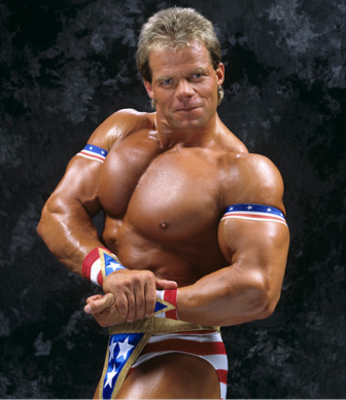
But just then, as the dejected crowd began to accept that it was over, a helicopter appeared and landed onboard the Intrepid.  The crowd buzzed with excitement wondering who would step out of the chopper to potentially save the day.  It was---Lex Luger…?!?  Up to that point, Lex had been a self-absorbed bad guy.  But on this day he was dressed in red white and blue, walking toward the ring with a purpose, throwing long-time supporter Bobby Heenan out of the way as he went.

When he got to the ring, Lex had a few choice words for Yoko and Fuji, telling them that bloodsuckers like them were the only thing wrong with America.  Despite their assertions that the contest was over, the crowd wouldn’t let the day end without Lex getting his shot.  They squared off and Yoko charged, which Lex dodged like a matador sending Yoko into the turnbuckle.  As he turned around, a bit staggered, Lex picked him up and bodyslammed him.  The crowd went wild and Luger celebrated like a mad man.  Other wrestlers picked him up on their shoulders as he waved American flags.  It was quickly dubbed “The Slam Heard ‘Round the World”. 

And with that, the Summer of Lex Luger was officially kicked off.


The Call to Action Campaign


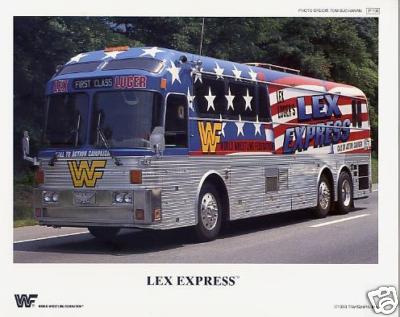
Lex immediately challenged Yokozuna for the title at Summerslam, but Yoko and Fuji declined the match.  So, Lex did what any warm-blooded American would do—he took his campaign to the people.  Dubbed the “Call to Action Campaign”, Lex spent several weeks in the Summer of ’93 traversing the country on a bus called “The Lex Express”.  He was shaking hands, kissing babies, signing autographs and making his case to the American people.  Now, why exactly he needed to make his case to the American people when the challenger for the title was not decided by popular vote is not completely clear.  But it doesn’t matter.  What matters is that the Call to Action Campaign produced the single most epic montage video in the history of professional wrestling.  I present to you, “I’ll Be Your Hero”:


There are so many great things about this video that it’s difficult to list them all. But a few of my favorites include:

  • the 80s-esque soundtrack
  • the “dramatic” camera shot of the Lex Express in the distance, gradually getting closer
  • Overlaid images of great Americans like a soldier, the Iwo Jima Memorial, George Washington and Abraham Lincoln
  • Lex wearing lightweight “stars and bars” sweats seemingly everywhere, including while sleeping on the Lex Express, hugging an American Flag pillow
  • Lex flexing in front of Niagra falls
  • Lex standing on top of the Lex Express and posing in front of Mount Rushmore
  • Lex’s expression at 3:15
  • Lex posing with a number of disabled kids
  • Lex wearing a fanny pack seemingly everywhere

Eventually the campaign accomplished its goal, and Lex was awarded his title shot against Yokozuna at Summerslam 1993.  

The Match

The stipulations indicated that it would be Lex’s one and only shot at the WWF tile.  As the crowd at the Palace of Auburn Hills waved flags and chanted “U-S-A, U-S-A”, Lex battled it out with the monstrous champion.  Lex eventually slammed Yoko once more, slightly less cleanly than the Slam Heard ‘Round the World.  With his patented running forearm, Lex was able to knock the behemoth out of the ring and win the match via count-out.  Unfortunately, the title cannot change hands via count-out.  As balloons fell from the ceiling and “The Stars & Stripes Forever” blared, Lex celebrated the win with other wrestlers, but it was a bittersweet victory as he was not able to win the title.

Lex went on to captain a team of “All-Americans” to a victory over The Foreign Fanatics at Summerslam 1993.  At the 1994 Royal Rumble, he was named co-winner along with Bret Hart, which set up a rematch with Yokozuna for the championship at Wrestlemania X.  While Luger clearly outwrestled Yokozuna and had him pinned, special guest referee (and former Luger nemesis) Mr. Perfect disqualified Lex for putting his hands on an official.  Lex would never reach his goal of winning the WWF title.  After feuding with Tatanka and the Million Dollar Corporation through the rest of 1994 and briefly teaming with the British Bulldog in early 1995, Lex left the WWF to return to WCW.


Miscellaneous Thoughts

This is one of my favorite wrestling angles of all time, because I feel that it really captured the essence of wrestling in the Golden Age.  All of the patriotism, the oversized and seemingly unbeatable heel, the muscle-bound face, the flag-waving, the cheesy montage… others may sneer at that paradigm for wrestling, writing it off as “wrestlecrap”.  But in its time it was awesome, and I love going back to watch it.  It was an era when wrestlers were larger than life, giants among men.  And wrestling matches weren’t just contests to see who got to wear a piece of gold around their waist, they were clashes of the titans to determine who was the best in the world.   


Conventional wisdom among the internet wrestling fan community is that the All-American storyline was a major failure for the WWF.  I wouldn’t deny that maybe it wasn’t exactly what they thought it would be.  From the moment the chopper began its descent onto the Intrepid, fans clearly thought it was going to be Hulk Hogan coming out to slam Yoko and save the day for the USA.  That was perfectly logical since after all, Hulk had wrestled at WWF King of the Ring just 3 weeks earlier, and back then nobody had the internet to clue us in when wrestlers were changing companies.  When it was Lex who showed up, people were clearly a bit disappointed; and since he had up to that point been a heel, fans were not as quick to latch on to him. 

WWE put the full strength of their hype machine behind Lex, and I personally enjoyed it.  But in truth, they were clearly trying to make Lex their new Hulk overnight which was simply impossible.  Lex may have been good, but nobody can walk in Hogan’s footsteps.  You can’t just recreate Hulkamania in the span of a month or two, no matter how good your marketing people are.  I think the summer of 1993 probably made that clear for Vince McMahon, who prior to that liked to think that his creativity and marketing were what really made Hulkamania explode.


Plus, by 1993, it wasn’t really what fans wanted anymore.  It was still a few years before the formal beginning of the Attitude Era, but by '93 fans had had enough of super-faces.  The crowd may not have been ready for the full-out anti-hero like Stone Cold Steve Austin yet, but they’d had enough of muscle-bound, flag-waiving, baby kissing good guys and they wanted something different.  Lex, in his stars and bars sweatpants and fanny pack, represented more of the same.  To that extent, I think WWF/Vince McMahon inadvertently set Lex up to fail by failing to realize that consumer preferences had evolved from the late 1980s.


But overall, I still think that angle went fairly well.  If you listen to the crowd at Summerslam 1993, they’re still very solidly in Lex’s corner.  A good portion of the fans were rooting for him to be crowned the winner of the Royal Rumble the next year and fans were solidly behind him again at Wrestlemania X.  Whatever his reasons were, Vince decided not to go through with the title change at Summerslam 1993, giving the fans a very unsatisfying count-out finish instead.  The common refrain about the storyline has thus become “Well, Lex just wasn’t getting over enough.  It just wasn’t working.  So they couldn’t give him the title.”  I disagree.  I don’t think giving the title to Lex at Summerslam 1993 would have been a disaster at all.  I think it would have been met with a favorable reaction from the crowd, just like Bret’s title wins in 1992 and 1994 were.  The decision to not give Lex the belt has changed most people’s perspectives on how the storyline actually went, in my opinion.  People assume that Lex must not have been too well-received if Vince didn’t give him the title, but in truth, the casual fan was very much behind Lex in ‘93.  I certainly have my issues with Lex Luger, particularly around his treatment of Miss Elizabeth in the weeks and months leading up to her death, and he doesn’t seem to have the greatest of reputations among other wrestlers of the era.  But I think his performance in the All American role was as much as you could have asked for, and I certainly have fond memories of what I consider to be a great summer for wrestling.

Until next time, enjoy the musical stylings of "Rappin'" Randy Savage and M.O.M.:


Happy 4th!